Functional networks of the cerebral cortex
The whole brain: seven networks
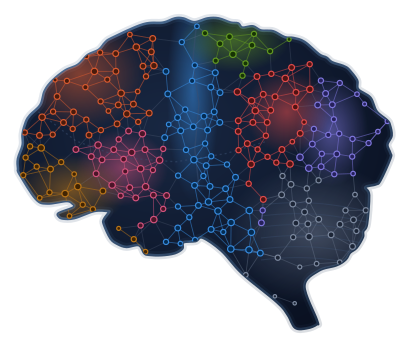
Even at rest, regions of the cortex that are far apart rise and fall in activity together. Regions that stay in step like this form a functional network. When Thomas Yeo and colleagues analysed resting-state fMRI scans from 1,000 people, the cortex divided reliably into the seven networks shown here in colour.
- Most networks are not one lump: each is a set of regions spread across several lobes, joined by long-range connections.
- Networks work together. Solving a problem, for example, draws on the frontoparietal control network to switch between the attention networks and the default mode network.
- The map covers the cerebral cortex only — deeper structures such as the hippocampus, amygdala and thalamus aren't part of it.
- Choose a network below to see where it is and what it does.
Seeing
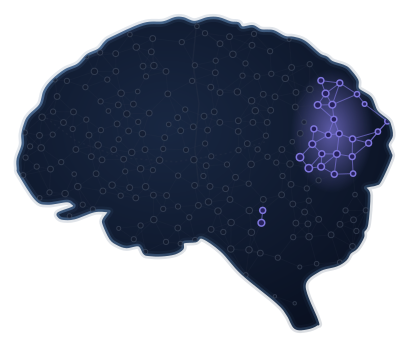
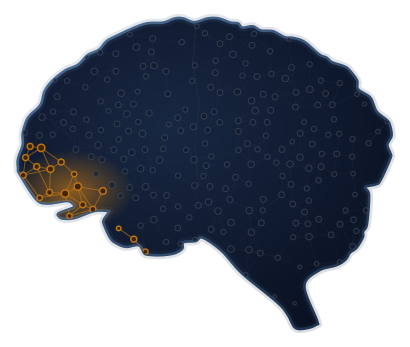
Visual network
Processes what we see — edges, shapes, colour and movement — beginning in the primary visual cortex at the back of the brain.
- Where
- The occipital lobe: the primary visual cortex (V1) and the visual areas around it.
- In use when
- Reading this sentence, recognising a face, following a moving ball.
- Worth knowing
- Damage here can blind part of the visual field even though the eyes themselves work normally.
Moving, touching and hearing
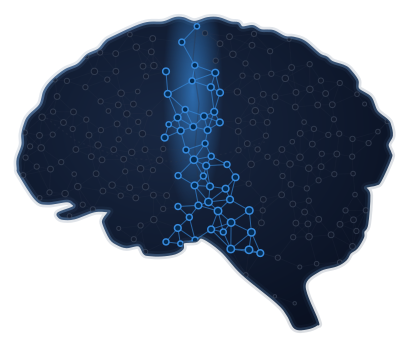
Somatomotor network
Controls voluntary movement and processes touch and the position of the body. In Yeo's map it also takes in the nearby auditory cortex.
- Where
- The strip either side of the central sulcus — the motor cortex in front and the somatosensory cortex behind — plus the auditory cortex in the temporal lobe.
- In use when
- Typing, walking, feeling that a mug is hot, hearing your name.
- Worth knowing
- The body is mapped in order along the strip (the "homunculus"). The hands and face take up far more of it than the back or legs.
Choosing where to focus
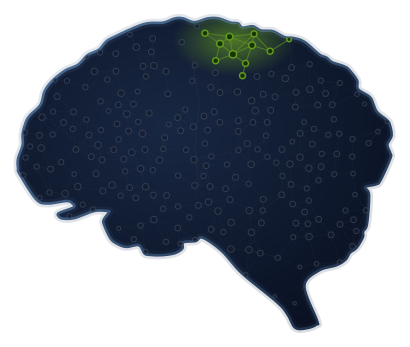
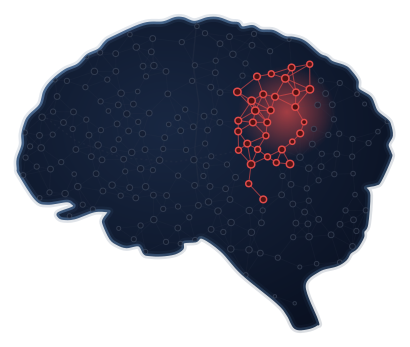
Dorsal attention network
Directs attention on purpose: top-down, goal-driven focus on a place or a feature, including planning where to look next.
- Where
- The intraparietal sulcus and superior parietal lobule, and the frontal eye fields.
- In use when
- Scanning a crowd for a friend in a red coat, keeping your eyes on the word you're reading.
- Worth knowing
- It works in partnership with the ventral attention network: the dorsal network chooses where to focus, and the ventral network interrupts when something unexpected happens.
Noticing what matters
Ventral attention (salience) network
Detects important or unexpected events — bottom-up attention — and helps the brain switch between inward thought and the outside world.
- Where
- The temporoparietal junction, the anterior insula, the ventral frontal cortex and the anterior cingulate cortex.
- In use when
- Turning when someone calls your name, noticing a smoke alarm, sensing that something "feels wrong".
- Worth knowing
- It overlaps closely with what many researchers call the salience network.
Emotion, reward and value
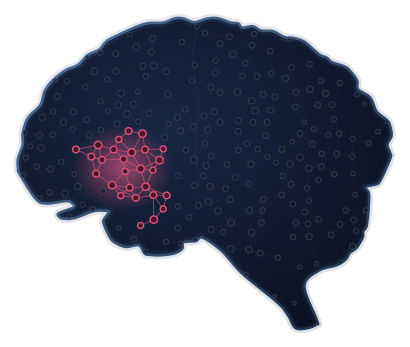
Limbic network
Attaches emotional meaning, reward and value to what we experience, helping us decide what matters and what to approach or avoid.
- Where
- The orbitofrontal cortex, just above the eyes, and the temporal poles.
- In use when
- Enjoying a favourite food, weighing up whether a reward is worth waiting for, reading the emotional tone of a situation.
- Worth knowing
- This is the cortical part of the limbic system only. The amygdala and hippocampus lie deeper, outside this map.
Planning and control
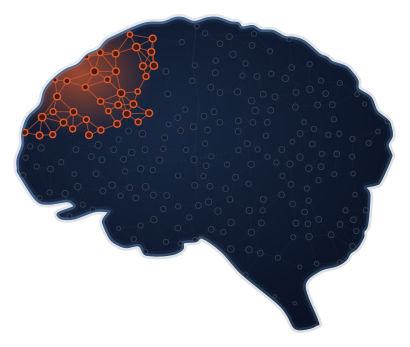
Frontoparietal (control) network
The brain's flexible control system: it holds information in working memory, makes plans and adjusts behaviour to reach a goal.
- Where
- The lateral prefrontal cortex and the posterior parietal cortex.
- In use when
- Doing mental arithmetic, following instructions with several steps, switching between tasks.
- Worth knowing
- It acts as a hub that co-ordinates the other networks, and is sometimes called the central executive network.
Thinking inward
Default mode network
Most active when we aren't focused on the outside world — daydreaming, remembering the past, imagining the future, and thinking about ourselves and other people.
- Where
- The medial prefrontal cortex, the posterior cingulate cortex and precuneus, and the angular gyrus, with links to the medial temporal lobe.
- In use when
- Mind-wandering in a quiet moment, replaying a conversation, planning the weekend.
- Worth knowing
- Its activity usually drops as soon as a demanding task begins. Unusual default mode activity has been linked to rumination in depression, and it is among the first networks affected in Alzheimer's disease.
Networks as mapped by Yeo, B. T. T. et al. (2011). The organisation of the human cerebral cortex estimated by intrinsic functional connectivity. Journal of Neurophysiology, 106(3), 1125–1165.